| INSTALLATION |
| VOTIVE TREE |
 |
|
 |
Material and Technique: 50m fabrics painted by the batik technique and surrounded a votive tree which had many colorful pieces of fabrics.
Location: Findikli Park (a public park in Istanbul).
Year: 1979
Concept: The votive tree is one of the old traditions, coming from Asia and shamanism. People put a piece of fabric on the tree make their hopes come true.
|
|
MADE IN SECTIONS
“CROSSINGS I” |
 |
 |
 |
 |
Material and Technique: Steel construction, special sera cover,water, mechanical equipment, sound effects and landscape paintings.
Location: At a loft in Tesvikiye, Istanbul
Year: 1994
Concept: Can humans live in a greenhouse? At this installation, visitors came from the city to enter a greenhouse. The “sera” is a symbol of today’s metropolis or more than this, a megapolis. The “environment” is where the humans were created,and as they became more evolved, more troubles were added and they began to complain.
It was hard to go in the greenhouse, through a narrow tunnel but people did it out of curiosity.They came face to face with a rainy cover and landscapes, parts of nature which she or he can remember. The landscape seems “whole” at first sight but actually it was a group of divided landscapes. There was only one way for people to leave this place: the same way he or she came in. He or she had to escape from this life which was created for him or herself. But to where?
……..”The nature here is just the moment, a rough drawing. Between you and children there are transparent plastic cover, water, rain and emptiness, which you never can fill up. The children are running towards to you, but to come together is impossible. You can go inside by the entrance at left; there are paintings, landscapes, but most of them looks unfinished or rough drawing. Actually we figure out suddenly that, nature, culture and technology is never finished. The installation is a symbol or a declaration of this unfinished world. Is this a dream, an illusion or a disappointment? Both of them maybe, some parts of a dream we are still living in it……..”
Critics by Onay Sozer ,writer and philosopher.
Sanat Cevresi Art Magazine, March 1994 |
|
MADE IN SECTIONS
‘’DOORS’’ |
 |
|
Material and Technique: Old-historical doors.
Year: 1994
Location: At a loft in Tesvikiye, Istanbul
Concept: This is an interpretation of Istanbul as a megapolis. People enter through a virtual labyrinth, which has visuals not of “Istanbul” but of a “ living Istanbul culture”. To exit this is not exiting from Istanbul, that is its not an escape. At the end of voyage, visions from the history to the future, there is an Istanbul vision, a big painting in all its magnificence. Istanbul is one of the oldest settled areas of mankind, the “ sea region” where all the worlds culture is blended. Istanbul is bounded by sea in all its history, but today it seems like a city that everybody likes to leave alone to face its destiny. There is a city, a region beyond the doors. There is a story, an adventure of culture developed by the sea, beyond the doors.
|
|
MADE IN SECTIONS
“WATER” |
 |
 |
Material and Technique: An area surrounds the panels of double glass filled with water, (specially made like an aquarium with tight width),and reagent compass stands in the middle of this structure.
Year: 1994
Location: At a loft in Tesvikiye, Istanbul
Concept: Science accepts the thesis that life began in the sea and came out of water. According to this thesis, there is an evolution by water in the origin of human beings, and human beings created civilization after they came out of water. This is the reason why humans lived by the seas, close to the water. The water is the source of life and is the source of culture.
The people who visit “Water” have to watch everything from behind the water. It is impossible to watch or see something without water in front of him or her. The visitor goes in an area, surrounded by panels, and sees the outside only through these panels of double glass full of water. Everything outside of this area can be seen by these water panels only. Humans are in a joint culture of water and even if they live on the soil.
|
|
THE AREA OUTSIDE OF THE PROGRAM – One of the Projects of the 1st Interdisciplinary Art Performance,
“Oh Beautiful Istanbul” |
 |
 |
Material and Technique: 5 transparent tablets
Year: 1994
Location: Yildiz Palace, Hasbahce, Istanbul
Concept: "…….Some areas of Hasbahce, the garden of the Yildiz Palace, were prohibited to the public to install our concepts. We marked these in the map of the garden and called it “the area outside of the program”.
The censor doesn’t darken the lights of the past and present art only, but closes the eyes of art’s future (the self-censor of the artist). The censor reaches the last point by prohibiting not only the ideas, but also words one by one……The full censor, which goes down even to the words, shows that the work of art is never prohibited fully, never fully programmed.
But art still can be fed by the censor………There is a glass wall between reality and us. We see everything when we look through the glass but we can comprehend nothing. If we look at the glass itself, we begin to understand everything even if we cannot see something at the back of the glass. We formed an “ area out of the program”, without closing the area, just covering it with transparent tablets, it was visible/ unvisible, but existing, crossable but prevented….."
(The article of Onay Sozer - Hurriyet Gosteri Magazin, November 1994,Turkey)
Artists: Sevil Soyer (Installation)
Onay Sozer (Text)
Gabriella Baptist (Text)
|
|
STILL TRANSFORMATION – One of the Projects of the 1st Interdisciplinary Art Performance,
“Oh Beautiful Istanbul” |
 |
 |
 |
Material and Technique: Steel construction, transparent plastic cover, special light effects , live music, special choreography.
Year: 1994
Location: Yildiz Palace, Silahhane, Istanbul
Concept: Istanbul has legends of foundation. It is said that for the construction of the city wall, many workers from far away were brought. Istanbul has been the “city of cultures” for centuries, with its existence, a centre of attraction and gravitation, it bears the traces of many civilizations without denying them, just like the domes which symbolize its architecture, like the seven hills on which it was established, it was covered, a city which absorbes everything, and in spite of this, it is in a very peculiar way a transparent city. One can only explain this city with a transparent dome. In its soft light constantly moving and enclosed in itself…The rushes,
migrations and captivations which started back in history are still continuing today. Sadik Altinok established his installation symmetrically on both sides of Sevil Soyer’s transparent dome. The dancer Berrak Yedek danced in the transparent dome of Istanbul and Candas Bas danced the "dance of migration" around Sevil Soyer’s transparent dome with the music of composers Birol Yayla and Senol Filiz.
Artists:Sevil Soyer (Installation)
Sadik Altinok (Installation)
Birol Yayla – Aziz Senol Filiz (Music)
Berrak Yedek – Candas Bas (Dance)
|
|
| CROSSINGS II |
 |
Material and Technique: Steel construction, painting, music, dance
Year: 1994
Location: Istanbul Technical University, Macka Campus, Istanbul
Concept: The effect of the global warming and the greenhouse are the most important environmental problems in the world. When you entered into the Sevil Soyer’s greenhouse you saw the dried landscapes, heard the drops of rain and watched the dancers as they danced for the productivity of the soil with shaman costumes. She invited the people to think about this and to do something for the future of our planet.
Artists:Sevil Soyer (Installation)
Berrak Yedek (Dance)
|
| |
| PROLOG |
|
|
| PURPLE RAIN – 2ND INTERDISCIPLINARY ART PERFORMANCE |
 |
 |
 |
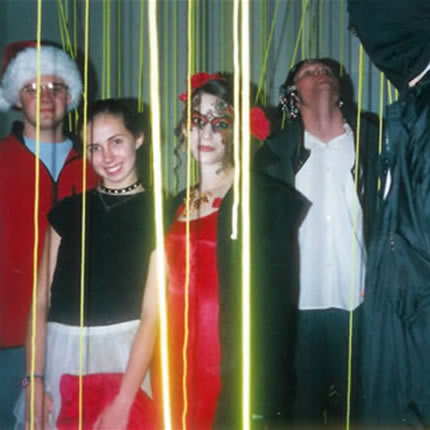
Material and Technique: Hundreds of multicolored strings, special light, live music (improvisation), poetry, special sound effects.
Year: 2003
Location: Turquoise Art Gallery, Michigan, USA
Concept: Sevil Soyer hung in the gallery hundreds of multicolored strings that represent rain. “….Purple is lonely and melancholy…Rain is very important for life and life can be happy and sad at the same time. Life has two faces….” said Sevil Soyer in her interview by The Daily Mining Gazette,October 23,2003.
“Purple Rain” was the 2nd interdisciplinary art performance of Sevil Soyer. The live performance included poetry, music and special sound effects by the artists of different disciplines. The musician Melvin Kangas improvised kantele music for the event. Lida Pelc is the author of six poetry anthologies, it was her first time tackling the topic of rain in her poems. During the event, Soyer used special rain effects produced by Omer Ahunbay and Hakan Ozer of Turkey. Professor and photographer Joe Kirkish narrated the poem.
Artists:Sevil Soyer (Installation)
Melvin Kangas (Music)
Lida Pelc (Poetry)
Joe Kirkish (Narrator)
|
|
|
|
|
|